

When food is wasted, so are our natural resources such as water, and energy used to grow them. Wildlife is sacrificed for the land used to grow crops.
On average worldwide we need 2350 calories per day to survive (we eat 180 kcal more). But at a global level we produce 5940 calories per day, and the rest is wasted – not harvested, lost during storage or distribution, replanted, fed to animals, or wasted by consumers at the end of the food chain.
Programs that support composting are preferable to food waste going into landfills and causing a rise in methane, but it still doesn’t address the land, water, emissions, pesticide and other threats to wildlife that went into producing the uneaten food in the first place. Cutting food waste by half would add 20% to the world food supply, and as we are facing a rising population over the next few decades, this is food that is needed. While a lot of improvements to the system need to be made by the producers and distributors, we can all still do our little bit too. Knowing when to eat food and when to throw it out came naturally to our grandparents, but now we seem to rely too much on use-by dates (that are there to encourage us to buy more!). Learn to use your eyes and nose to know when your food is fresh.
Tips for recognising if your food is still good to eat –
Baking powder – sprinkle ½ teaspoon into a bowl and pour over 60ml of boiling water. It should bubble up right away. If it doesn’t, throw it away.
Butter – cut into the butter – if the colour on the inside is the same as the outside, the butter is still fresh. If the outer colour is darker, the butter has oxidised and may be rancid.
Bread – If bread smells of mould (or is mouldy!) don’t eat it, as mould spores may be present even if they cannot be seen.
Cheese – the salt content in hard cheese makes it less vulnerable to mould than soft cheese, but it is possible to cut off a little mould and the cheese still tasting ok. Too much mould and it needs to be thrown away.
Chicken – fresh chicken has a light pink colour (or if corn-fed may be closer to light golden). As it loses its’ freshness it will start to turn grey. Raw chicken that is starting to go off will also have a very potent odour.
Dried Fruit – will just get drier the longer you keep it, but if you are putting it in a cake that’s fine. You can soak it in a little juice or green tea to bring it back to life.
Eggs – fill a glass with cold water and drop the egg in. If it’s fresh it will lie horizontally at the bottom of the glass. If it sinks to the bottom but tilts up halfway it’s not fresh but still good to eat. If it floats, it’s stale. You can also use your nose – crack it into a bowl and have a sniff – you will definitely know if it’s off!
Fish – despite what most people think, fish should not smell really fishy – just fresh and clean. If the fish smell is overwhelming or ammonia-like, the fish is past its best.
Flour – weevils can be present in flour that has been hanging around for too long, but if you are using the flour to bake or heat up in other ways the high temperature will kill them.
Milk – if stored properly in the fridge milk will last 7 days past it’s sell-by date (lactose-free or fat-free may last up to 10 days). Use your nose – fresh milk shouldn’t have much of a smell, but in contrast soured milk is pretty unpleasant. If there are any lumps in the milk – it’s definitely time for the bin! Oat or almond milks tend not to change even past their use-by date, so taste them tentatively.
Nuts – Some of the mould found in nuts can be seriously toxic, so do avoid out-of-date nuts. They also tend to go rancid before mouldy, so again, use your nose!
Oil – some oils go off must faster than others, and the smell and taste of rancid oil if pretty distinct. Smell and taste before using each time if you are in doubt.
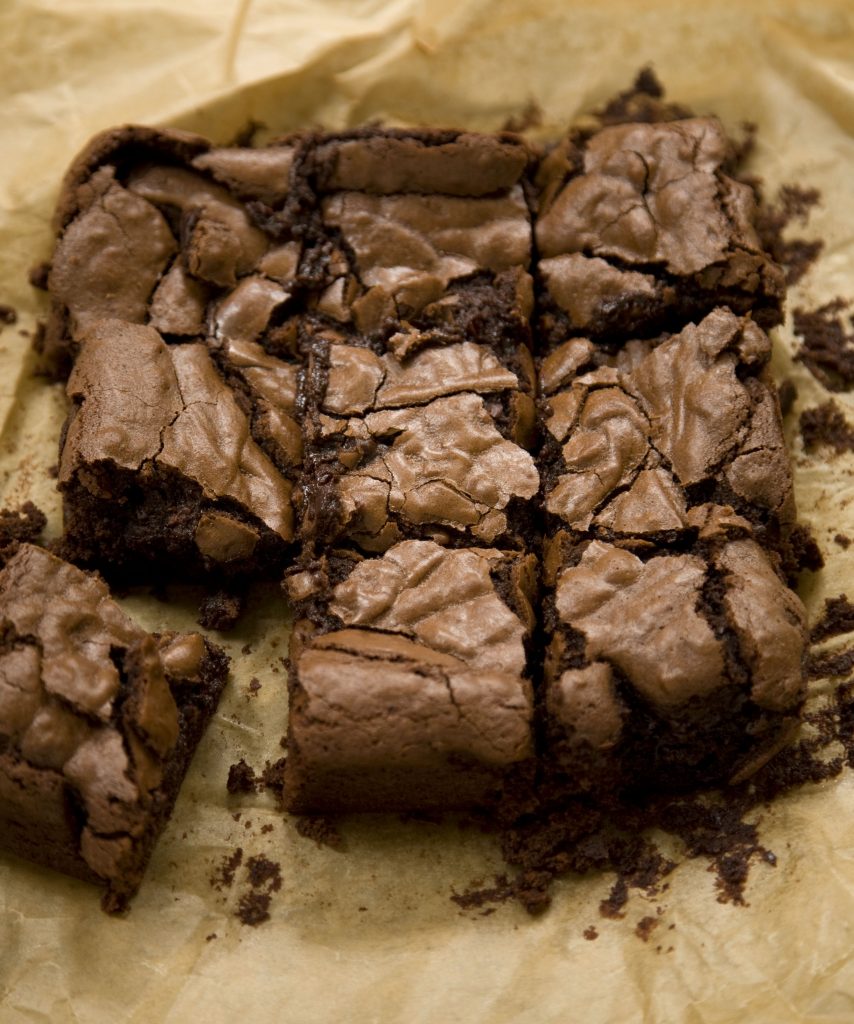
Another way to avoid food waste is to ensure you use every morsel of food where you can. So after opening a tin of chickpeas for a curry I was determined to use the aquafaba – what better excuse for a chocolate brownie for afternoon tea?!
Chocolate Brownies (vegan or not, it’s up to you!)
Makes 9-12
175g dark chocolate, roughly chopped
110g vegan butter substitute (or butter)
120ml aquafaba
250g light muscovado sugar
175g plain flour, sifted
45g cocoa powder, sifted
2 tbsp cacao nibs
- Preheat the oven to 190°C, 170°C fan, Gas mark 5. Line a 20 x 20cm tin with baking paper.
- Place the chocolate and butter in a bowl over a pan of simmering water and melt slowly, stirring occasionally. Remove from the heat and allow to cool slightly.
- Meanwhile, place the aquafaba and sugar in a large bowl and, using an electric whisk, whisk until thick and creamy – to ribbon stage.
- Using a rubber spatula, fold the melted chocolate mixture into the aquafaba, followed by the sifted flour and cocoa powder, and cacao nibs.
- Bake for 30-45 minutes. Leave to cool in the tin before cutting into 9 or 12 pieces (depending on how greedy you feel!).