
There are hundreds of ways to make sourdough bread, and some recipes look far more complicated than it needs to be. This is a very simple way to start your first loaf, and after that I suggest you play and experiment as much as you can, until you become a master at using different flours, shapes, and flavours.
Starter – this takes 3-4 days to make – there is nothing magic about it, it’s just flour and water that uses bacteria from the air around us to produce a ‘wild yeast’.
In a clean glass jar, mix together 50g of strong organic bread flour (you can use white, wholegrain, rye or spelt, or a mixture) with 50g (measured on scales) of tepid (never hot) water. It should have a fairly thick consistency and not slide off the spoon easily. Stir together then leave to rest for a day with the lid resting on the jar but not tightly closed, allowing a little air in.
On day 2 add another 50g flour and 50g water, stir and leave partially covered again.
On day 3 add 50g flour and 50g water as above.
On day 4 you should see bubbles rising in the starter, if not add 50g flour and 50g water and leave as before.
Once you have bubbles, your starter is ready to use. Any unused starter can be stored in the fridge, or continue to feed as above for your next loaf.
Bread – this takes up to 2 days to make
500g flour (a high percentage of white may be best for your first loaf)
1 ¼ tsp salt
250g starter
275g tepid water
In a large bowl, mix together the flour and salt and make a well in the centre. Add the starter and water and mix together to make a dough.
Oil a bowl and place the dough in the bowl, cover with an oiled shower cap or damp tea towel for 4-5 hours (you can leave it overnight). Don’t expect it to double in size, but it should rise a little.
Once it has risen, ease the dough out of the bowl onto a floured surface, trying not to deflate it too much. Take a corner of the dough and bring it to the middle, then rotate the dough and repeat with the next corner. Continue doing this to form a ball with the dough.
If you have a baker’s proving basket (banneton), dust it generously with flour. Alternatively line a medium sized bowl with a clean tea towel that you have dusted generously with flour. Place the ball of dough in the bowl, seam side up and cover again with oiled shower cap or damp tea towel, and leave for 3-5 hours until it has risen slightly in the basket or bowl.
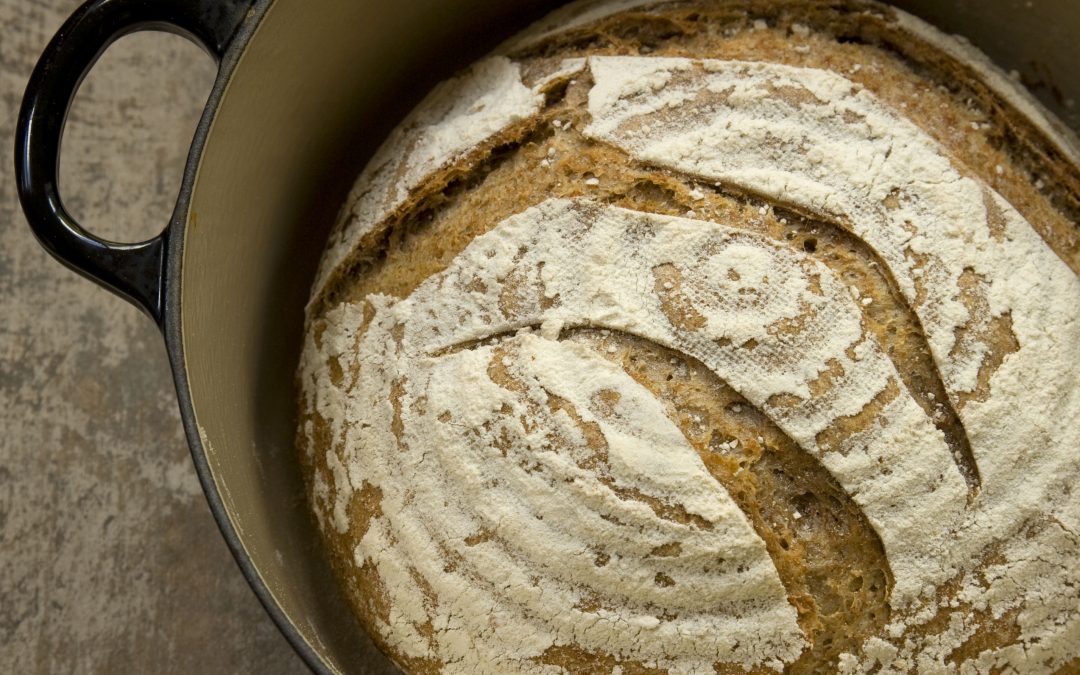
When you are ready to bake preheat the oven to 250°C (or as hot as it will go) for at least 30 minutes. Dust a baking sheet with flour or semolina, and place a shallow ovenproof dish of boiling water in the lower part of the oven (to give a steamy effect which allows the crust to form). If you prefer, you can bake in a large cast iron casserole – dust with flour first.
Turn the dough out onto the baking tray, or into the casserole, so the seam side is down and slash the top with a very sharp knife. Bake for 10 minutes then reduce the temperature to 190°C, 170°C fan for 35-40 minutes. It should sound hollow when tapped underneath when it is cooked through. If cooking in a casserole, the boiling water is not needed and the cooking times are – 15 minutes at 250°C, 230°C fan for 15 minutes (with the lid on), then reduce the temperature to 190°C, 170°C fan for 15 minutes (with the lid on) and then for the final 15 minutes remove the lid.
Cool on a rack before slicing into the loaf.